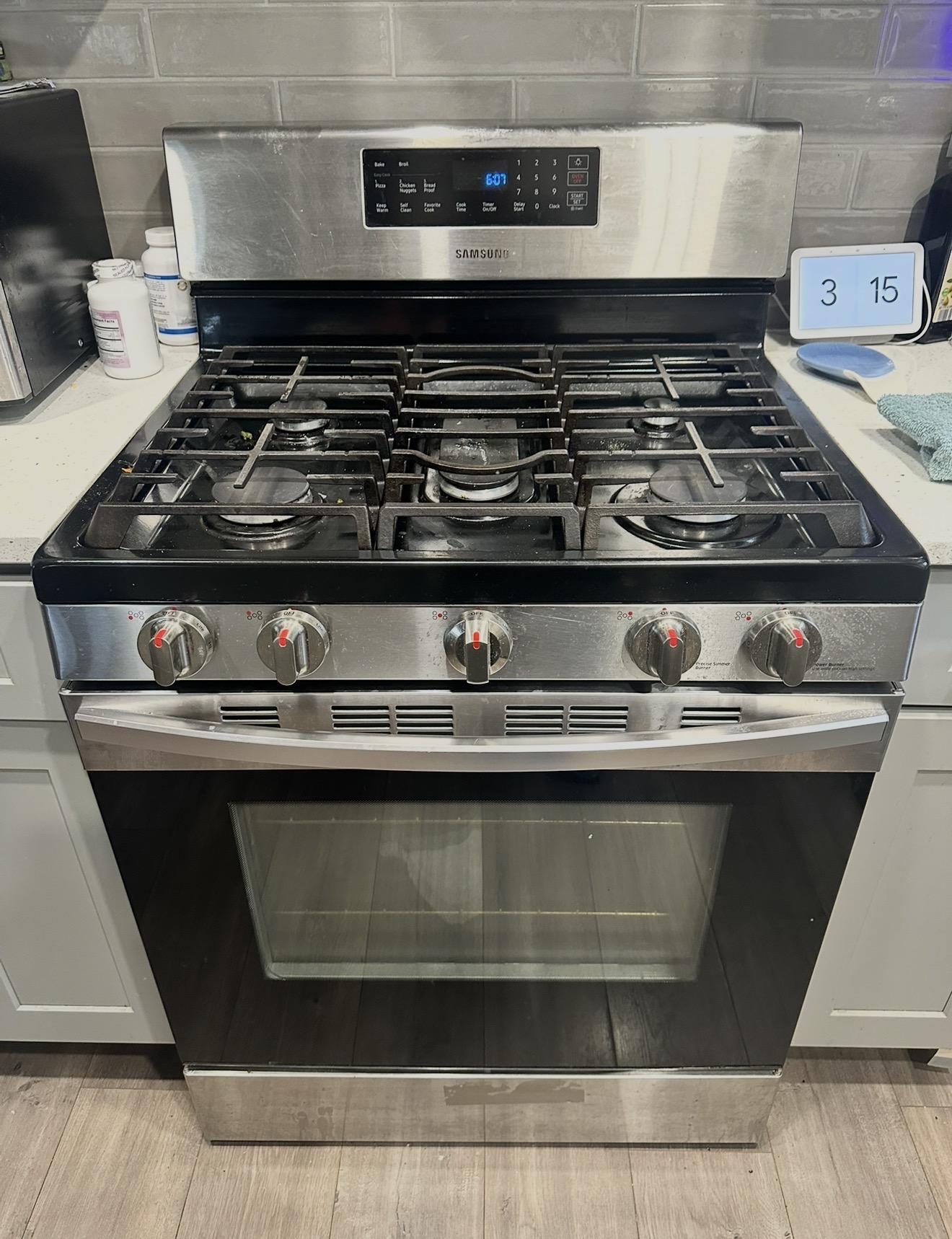
Igniter died too soon · Multiple parts failing · Burner cap warped · Gasket compressed · Oven dies young in your busy family kitchen — same-day Samsung repair across Great Kills
$80 diagnostic · Exact repair price after diagnosis · 90-day warranty
GET A CALLBACK
Describe the problem — Badma will call to confirm the likely fix and same-day availability across Great Kills, Buffalo Skating border, and the lower Hylan Blvd corridor.
Samsung Oven Repair — Great Kills 10308
"This is the second igniter in five years." "Why does this oven feel like it dies every two years?" "Three different things broke this winter — is it the oven or is it me?" Calls from Great Kills sound different than calls from anywhere else on Staten Island. Your oven is not unusually defective. Your kitchen is unusually busy. Family households cooking 5–7 nights a week put cycle counts on a Samsung gas range that the engineers designed for an average household — and the parts wear out on cycle count, not on calendar age.
Premier Appliance Repair's flat $80 diagnostic covers the trip to your Great Kills home, full on-site testing, and a written quote with the exact repair price. Approve and the $80 applies toward the repair. Decline and you pay only the $80, no upsell. Most 10308 calls finish same-visit because the parts that wear out from heavy cycle counts are the parts Badma carries on the truck.
Safety first — gas smell is not a DIY situation. If you smell gas (and not just a brief whiff when a burner first lights), turn off the range, open windows, do not flip any light switches, and call National Grid at 1-718-643-4050. They respond 24/7 free of charge and will shut off the supply if there's a leak. Only after the gas situation is safe, call us.
Great Kills runs along the south shore between Hylan Blvd and the harbor. The neighborhood was built largely between the 1960s and the 1980s — single-family homes, mid-size lots, attached garages, two-car driveways. The demographic is the most family-centric on Staten Island: school-age kids, sports schedules, dinner-on-the-table at 6:30 every weeknight, weekend grilling that still uses the oven for sides. Hylan Blvd handles the shopping, Amboy Rd the local errands, Great Kills Park the recreation. Buffalo St and Buel Ave anchor the older residential blocks. Great Kills Park's preserved coastal woodland borders the south end.
What this means for Samsung ranges: cycle count outpaces calendar age. Every time you preheat the oven, that's a cycle on the bake igniter — power applied, igniter glows hot, gas valve opens, igniter cools when the cycle ends. Samsung's bake igniter (DG94-01012A on most NX58 models) is typically rated for thousands of cycles. A two-person household uses the oven maybe 200–300 times a year — eight years to reach 2,000 cycles. A Great Kills family kitchen with daily dinners plus weekend baking hits 600–800 cycles per year — same 2,000 in three years. By year four, the igniter is at 60–70% of its rated lifetime budget. Year five, it's borrowed time.
Same logic applies to door gaskets (rated ~5,000 open/close cycles, family kitchens hit that in 6–7 years), surface burner caps (deform from repeated boilovers — pasta night, taco Tuesday, the once-a-month chili), and the spark module that fires the cooktop electrodes (rated for total spark count). The pattern: parts fail on cycle count, and when one component nears end-of-life, the others are usually close behind.
That's why we tell Great Kills callers something we don't usually say: after the first major repair on a Samsung range that's seen heavy use, ask Badma what else is close to failing. Replacing two adjacent components on one visit is cheaper than two separate trip charges later.
The most common Great Kills repair. Igniter testing is straightforward. Set the oven to Bake 350°F. Open the oven door, turn the oven light on, watch through the window.
Within 30 to 60 seconds a bright orange glow should appear at the bottom of the cavity — that's the bake igniter heating up. A few seconds later, a blue flame should ignite from the burner port behind it. Three outcomes:
(a) Glow appears, but no flame ever ignites. The igniter still glows but no longer pulls enough current to open the gas safety valve. Replacement.
(b) Glow takes longer than 90 seconds. Industry repair guidance treats this as a sign of a weakening igniter. In a Great Kills cycle-heavy kitchen this is usually the year-3 or year-4 warning sign. Replace before failure.
(c) No glow at all. Dead igniter, broken wire, or relay fault on the control board. Multimeter test: a healthy igniter reads 10–2,500 ohms.
Badma carries DG94-01012A and the common variants on the truck. Same-visit repair.
The door gasket is designed for thousands of open/close cycles. Every time you open the door to baste, check, or rotate a sheet pan, that's wear. A two-person household opening the oven 200 times a year takes 25 years to hit 5,000. A Great Kills weeknight kitchen with a basting parent and a checking kid hits 5,000 in 6–7 years.
Symptoms of a gasket past its cycle budget: (1) oven preheats slower than it used to (10 extra minutes to 350°F is the typical complaint). (2) the kitchen warms noticeably when the oven is on. (3) visible compression marks, tears, or gaps when you run a finger around the gasket perimeter.
Test it: open the door, run your finger slowly around the seal. Plump, springy, uniform = good. Squishy in spots, crusty in others, or with visible flat zones = past lifetime. Don't try to replace it yourself. The gasket is held by clips that break if you pull on the rubber, and an uneven seal makes the heat-loss problem worse.
The burner cap is the round black metal piece sitting on top of each surface burner. New caps are flat, evenly black, sitting square on the burner head. After years of pasta-water boilovers, sauce splatter, and high-heat sears, caps in heavy-use kitchens warp. Symptoms:
Cap rocks instead of sitting flat. The flame may also lift off the burner or burn yellow instead of blue.
Cap is visibly dished or peaked. Heat-induced warping. Replacement.
Cap is heavily rust-pitted or discolored white. Past the point of cleaning. Replacement is cheap on most Samsung models.
Tell Badma which burner — front-left, rear-right, etc. — is affected. Surface burner caps are model-specific and we keep the common Samsung NX58 caps in stock.
If your Samsung range has hit the 5–7 year mark with heavy use, you may notice a cluster of issues: igniter weakening, gasket compressed, one burner cap warped, the oven thermometer reads 30°F off the display. They didn't all coincidentally fail in the same year. They all reached cycle threshold near the same time because they were installed at the same time and aged at the same rate against your usage pattern.
The economic question becomes: replace one part now and another in 4 months when the next thing fails, paying the trip charge twice — or replace the cluster on one visit, get one trip charge, end up with a refreshed range that performs like new for another 5–7 years. We don't push this conversation, and we never tell anyone what to do, but Badma will be straight about the math when he diagnoses on-site. You decide.
1. Demo mode is on. If your range was a floor model, recently moved, or hit by a storm-related power surge, it might be in Demo mode. Display will show "d", "D", "tESt", or "DEMO." Cooktop works on gas ranges but oven won't heat. Hold the Options button and follow the user manual prompt to exit.
2. The breaker. Even gas ovens need 120V electricity. Check the panel for a breaker labeled "Range" or "Oven." Cycle fully OFF for 30 seconds, then ON. Note: a half-tripped breaker gives confusing partial-power symptoms; flip it all the way OFF first.
3. The door. Samsung ovens shut off automatically if the door is left open more than about a minute. Make sure the door is fully closed. Sometimes a roasting pan handle catches the door at a small gap that's invisible from the front. Pull the door fully open, slide all racks back, close firmly.
"My Samsung oven won't heat" can be a $40 igniter, a $90 sensor, a $180 control board relay, or a wider repair if the cluster has hit. We test on-site, write out the price, give you the number. Approve and the $80 diagnostic applies toward the total. Decline and you pay only the $80 and Badma leaves. No upsells, no surprises after the work starts. Same approach across Great Kills, Buel Ave, Buffalo St, Hylan Blvd, and the entire 10308 ZIP.
Why Choose Premier
| Factor | 🏢 Samsung Service | 🔧 Premier Appliance |
|---|---|---|
| Arrival in Great Kills | ❌ 5–14 day wait | ✅ Same-day |
| Free phone advice before a visit | ❌ Queue & script | ✓ Always |
| Diagnostic fee | ❌ $100–150+ | ✅ $80, applied |
| Price quoted before work starts | ❌ Not always | ✅ Always in writing |
| Warranty | ❌ Varies | ✅ 90-day guarantee |
| Weekend availability | ❌ Weekdays only | ✅ Mon–Sun |
Honest, Transparent Pricing
Book Your Visit
Same-day diagnosis — $80 flat, exact repair price after we see the problem. Badma covers Hylan Blvd, Amboy Rd, Buffalo St, Buel Ave, and all of ZIP 10308.
📅 Book Online Now 📞 (929) 261-4444Samsung Oven Error Codes & Display Diagnostics
In family kitchens cooking 5–7 nights a week, certain Samsung error codes show up before the calendar suggests they should — because parts wear on cycle count, not on age. Igniter-related codes (E-08), gasket-driven preheat issues, and burner cluster problems lead the list.
E-08 is the most common 10308 code. Translation: the oven failed to hit your set temperature within the time window the control board expects. In a high-cycle Great Kills kitchen, this almost always traces to a bake igniter that has burned through its cycle budget — usually around the 3–5 year mark on a busy family schedule.
If you replaced this igniter before — and the new one died at year 3 again — that's cycle-count math. The part is doing what it should; your kitchen is just busy. Same-visit repair with DG94-01012A (most NX58 models). Call (929) 261-4444 →
C-d0 means the control reads a touch button as continuously held. Cooking spatter and grease on the panel are typical causes. In family kitchens with daily heavy cooking, this code shows up earlier than the borough average.
Persistent C-d0 means the membrane switch under the touch surface or the control board has failed. On a 10308 oven that has hit the 4–5 year mark, this is sometimes the second component to go in a cluster. Call (929) 261-4444 →
C-d1 indicates the control board sees an electrical short in either the touch panel circuit or the door lock circuit. On family ovens with frequent door open/close cycles, lock motor wear is a real factor.
If your oven is in the cluster-failure window, ask Badma to check related components while he's in there. Call (929) 261-4444 →
C-20 indicates the oven temperature sensor — a thermistor in the cavity — is reading a value the control rejects. C-21 is the more serious over-temperature warning. Temperature sensors drift faster in heavy-use kitchens because cumulative thermal cycling shifts the calibration.
Sensor (DG32-00002B) is the standard fix. In Great Kills high-use households, sensor drift often becomes noticeable around year 5–6. Call (929) 261-4444 →
The main relay board and display board exchange data over a flat ribbon cable. C-F0 means that connection has failed. Power surges from storms or grid events are the typical trigger.
If it keeps coming back, ribbon cable reseat or relay board (DG92-01084E) replacement. Call (929) 261-4444 →
LE shows when the door lock motor is engaged but cannot return to unlocked. Self-clean cycles trigger the lock. In family kitchens that run self-clean rarely (most Great Kills owners do quick wipe-downs instead), this code is less frequent than in 10304 entertaining ZIPs — but lock motors still wear from regular open/close.
Standard same-visit repair on most NX58 models. Call (929) 261-4444 →
C-F2 means the convection fan is not turning when convection mode requires it. In heavy-use family kitchens, convection bake is used often (faster results, more even cooking) and the fan motor accumulates hours faster than the borough average.
Convection fan motor is a standard same-visit repair. Call (929) 261-4444 →
Sometimes the oven simply will not heat (or will not turn on) and the display shows no error code at all. In 10308 cycle-heavy kitchens, this often points to silent component failures — a part that has gone fully open-circuit instead of reading out-of-range, so the control board has nothing to flag.
Common 10308 silent-failure pattern: an igniter that has been weakening for months finally goes completely dead overnight. Same-visit repair. Call (929) 261-4444 →
Common Samsung Oven Problems — Great Kills 10308
If your Samsung gas oven igniter failed at 3–5 years instead of the typical 8–10, you are not unlucky. Family kitchens cooking 5–7 nights a week burn through the igniter cycle budget in roughly half the time of an average household. Quick test before calling:
Bake igniter (DG94-01012A on most NX58 models) is a standard same-visit repair. Call (929) 261-4444 →
Common in Great Kills cycle-heavy households. After 5–7 years of family cooking, several components hit cycle threshold within months of each other — they were installed together and aged at the same rate against your usage pattern.
Replacing the cluster on one visit is cheaper than the same repairs spread over multiple service trips. Badma will give you the math on-site, and you decide. Call (929) 261-4444 →
The burner cap is the round black metal piece sitting on top of each surface burner. After years of pasta-water boilovers and high-heat searing, caps in heavy-use kitchens warp from thermal shock. Symptoms:
Tell Badma which burner — front-left, rear-right, etc. — is affected. Surface burner caps are model-specific and we keep the common Samsung NX58 caps in stock. Call (929) 261-4444 →
Universal first check: rule out the false alarms before calling for service.
If glow appears but flame never lights, igniter needs replacement. Call (929) 261-4444 →
Different from "won't heat" — here the controls are dead. Even gas ovens need 120V electricity for the controls.
If display still won't power up, control board, ribbon cable, or internal power supply has failed. Call (929) 261-4444 →
If the oven heats but takes 25–30 minutes to reach 350°F, three things to check in a 10308 cycle-heavy household:
In family kitchens at the 5+ year mark, all three of these often appear together — the cluster pattern. Call (929) 261-4444 →
Do not try to fix this yourself. Turn off the range. Open windows. Don't flip any light switches or use lighters.
We do not service live gas leaks — that is utility-company work. Once the gas is safe, we fix the appliance. Call (929) 261-4444 →
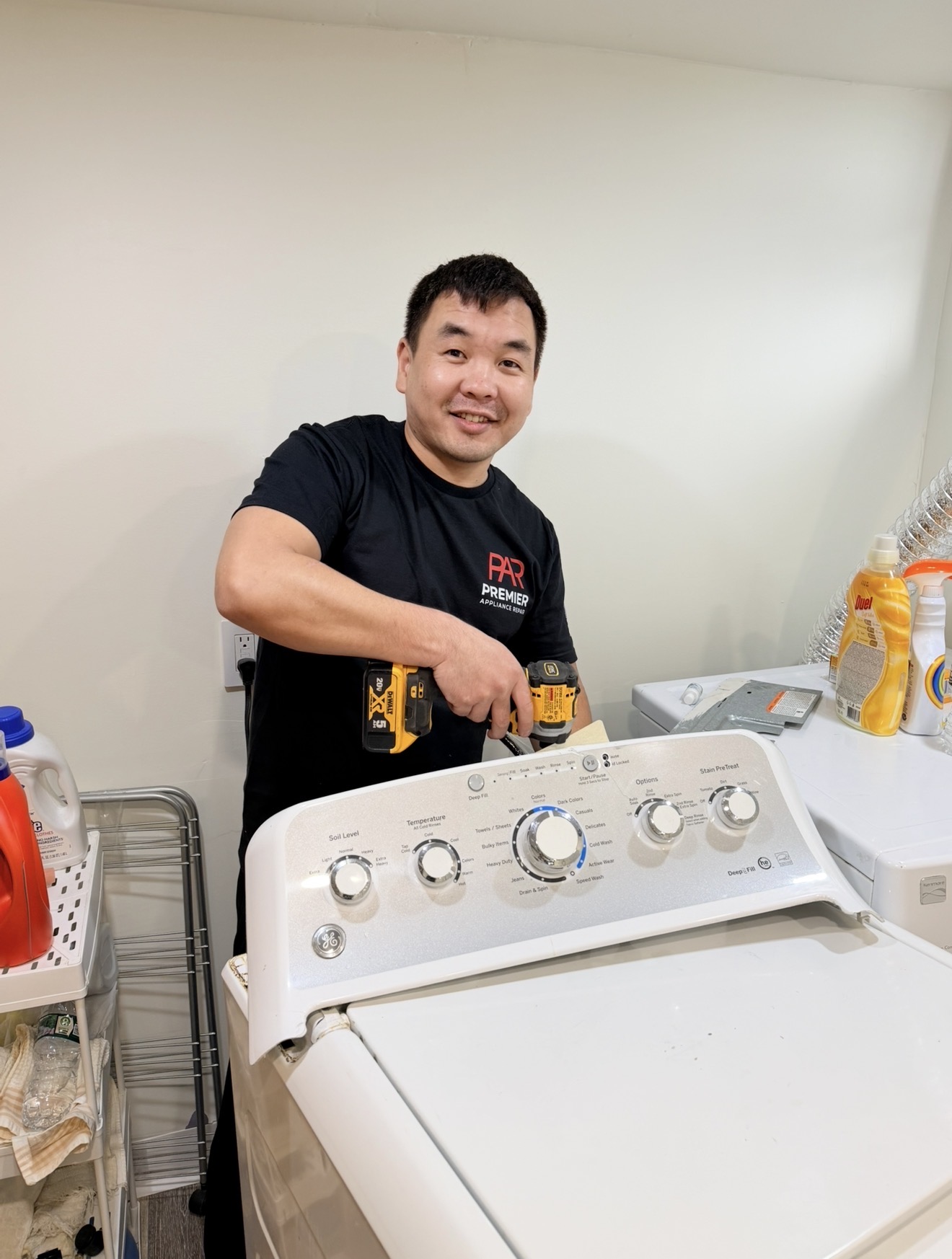
Your Technician
The Repair Process
Call (929) 261-4444 or book online. Share your Samsung range model number (on the label inside the door frame) and a short description of what's happening — the error code, whether the burner clicks, whether you saw the igniter glow. Badma often has specific troubleshooting to try on the phone before scheduling, and some issues get solved in 5 minutes at no cost.
📅 7 Days a WeekBadma arrives, inspects the range, and tests the relevant components — bake igniter, spark module, spark electrode, temperature sensor, door lock motor, control board, wiring — to identify exactly what has failed. The $80 covers the visit and the diagnosis regardless of how long it takes.
You get the exact repair price in writing — the specific part, its cost, and the labor. If you approve, the $80 diagnostic applies toward the total. If you decide not to proceed, you pay only the $80 and Badma leaves. No pressure, no upsell.
Most common Samsung gas range parts — bake igniters, spark electrodes, temperature sensors, door lock motors, common control boards — are on Badma's truck. Special-order parts are ordered and installed on a second visit, typically 1–3 business days. Every completed repair carries a 90-day parts and labor warranty.
🛡️ 90-Day WarrantyServing Great Kills & the 10308 ZIP
Great Kills sits along the south shore of Staten Island between Hylan Blvd and the harbor. The neighborhood runs from the Eltingville border on the west to the New Dorp side on the east, with Great Kills Park and Crooke's Point providing the southern coastline. Most of the area was built between the 1960s and the 1980s — single-family homes on mid-size lots, attached two-car garages, established residential streets like Buffalo St, Buel Ave, Hopping Ave, and Locust Ave. Hylan Blvd handles the main shopping corridor with the Eltingville Plaza shopping center near the western edge; Amboy Rd runs through the local errands area. Great Kills Park's preserved coastal woodland borders the south end. The demographic skew is the most family-centric on Staten Island — school-age kids, sports schedules, daily-dinner kitchens. That cooking pattern is what drives the unique Samsung oven failure profile in this ZIP. Badma covers the full area same-day: Hylan Blvd, Amboy Rd, Buffalo St, Buel Ave, Hopping Ave, Locust Ave, Greaves Ln, Hillside Terrace, and throughout Great Kills, the 10308 portion of Eltingville border, and adjacent harbor-side blocks.
Loading live reviews from Google…
Frequently Asked Questions
It is the cycle count, not the calendar age. Samsung bake igniters (DG94-01012A on most NX58 models) are typically lasts 6–10 years under normal use, working out to thousands of ignition cycles. A two-person household reaches 2,000 cycles in about 8 years — well within budget. A Great Kills family kitchen cooking 5–7 nights a week with weekend baking hits 600–800 cycles per year — same 2,000 cycles in just 3 years. By year 4 the igniter is at 60–70% of its rated lifetime budget. Year 5 is borrowed time. The part is doing exactly what it should; your kitchen is just unusually busy. Standard same-visit repair.
Common in 10308 cycle-heavy households. Components were installed at the same time and aged at the same rate against your usage pattern, so they reach end-of-life within months of each other. Typical 5–7 year cluster: igniter weakens (slow preheat), door gasket compresses (heat escapes), one burner cap warps (flame lifts off), temperature sensor drifts (oven thermometer reads 30°F off display). Replacing the cluster on one visit is cheaper than the same repairs spread over multiple service trips. Badma will tell you straight what is close to failing during the on-site diagnosis.
Cycle count math. The door gasket is designed for thousands of open-and-close cycles. A two-person household opening the oven 200 times a year takes 25 years to reach 5,000 cycles. A Great Kills weeknight kitchen with a basting parent and a checking kid hits 5,000 cycles in 6–7 years. Symptoms: slow preheat, kitchen warms when oven runs, visible compression marks or gaps in the gasket. Test by running a finger around the seal — plump and uniform means good, squishy or crusty means past lifetime. Don't try to replace it yourself — gasket clips break if pulled.
The burner cap — the round black metal piece on top of each surface burner — warps from years of high-heat thermal shock. Pasta-water boilovers, sauce splatters, high-heat sears all add up. Symptoms: cap rocks instead of sitting flat (flame may also lift off the burner or burn yellow instead of blue), cap is visibly dished or peaked, cap is heavily rust-pitted or discolored white. Replacement caps are model-specific. Common Samsung NX58 caps are kept in stock for same-visit repair. Tell Badma which burner is affected when you call.
On a heavily-used oven that has hit the 5–7 year mark, yes — at least talk through the math with Badma during the diagnostic. Pre-emptive replacement saves money in three ways: (1) one trip charge instead of several, (2) you avoid the worst-case scenario of an oven failing mid-Thanksgiving-prep, (3) parts replaced together perform consistently because they have the same age. We don't push this conversation unless the oven is showing multiple end-of-life symptoms. We never tell anyone what to do. If only one component has failed, we just replace the one component.
On Samsung gas ovens (NX58 series), the most common cause is a weak bake igniter — it still glows but no longer pulls enough current to open the gas safety valve. In a 10308 cycle-heavy kitchen this happens at year 3–5 instead of the typical 8–10. Test: set Bake 350°F and watch through the oven window. Within 30–60 seconds you should see an orange glow, followed by a blue flame. Glow but no flame = weak igniter. Other quick checks: make sure Demo mode is not on (display shows "d" or "tESt"), the door is fully closed, and the breaker is not tripped.
Three common causes in 10308 cycle-heavy kitchens, often appearing together: (1) Door gasket compressed from years of open-and-close cycles. Run a finger around the seal — squishy or crusty in spots means past lifetime. (2) Bake igniter weakening — even when it lights the burner, a weak igniter cycles the gas valve open inefficiently, slowing preheat. (3) Temperature sensor drifting (DG32-00002B). Buy a $6 oven thermometer and check actual vs displayed temperature. Off by more than 35°F means sensor replacement needed. In Great Kills family kitchens past 5 years, all three often need attention at the same time.
Different from "won't heat" — here the controls are dead too. Even gas ovens need 120V electricity for the display, controls, and igniter. Three steps: (1) Check the breaker labeled "Range" or "Oven." Flip OFF for 30 seconds, then ON. (2) Verify the wall outlet — over years the plug behind the range can vibrate loose. (3) Try a longer power cycle: breaker OFF for 5 minutes, then ON. If display still won't power up, the control board, ribbon cable, or internal power supply has failed.
The diagnostic is $80 flat — covers the trip to your Great Kills home, full on-site testing, cycle-count assessment for high-use family kitchens, and a written quote. After diagnosis, the repair price depends on which part failed. Igniter replacement is the most common 10308 repair and runs in the lower-to-mid range. Multi-component cluster repairs (igniter + gasket + sensor on one visit) cost more in parts but save money overall vs separate trips. We don't quote over the phone because parts and labor differ by model. You get the exact price in writing before any work starts. If you approve, the $80 applies toward the total. If not, you pay only the $80 and Badma leaves.
Yes — the full 10308 ZIP. Great Kills running along the harbor side from Hylan Blvd to the Crooke's Point area. Buffalo St and Buel Ave through the older residential blocks. Lower Hylan Blvd toward the Eltingville border. Amboy Rd through the local shopping district. Same-day service 7 days a week: Mon–Sat 8am–7pm, Sun 9am–5pm. Same diagnostic price and same warranty regardless of where in 10308 you are. Badma understands the cycle-count failure profile in family-heavy kitchens and stocks the parts that fail most often here.
Ready to Fix It
Same-day service across ZIP 10308. $80 diagnostic, exact repair price after we see the problem, 90-day warranty on every completed repair. Cycle-count assessment included for high-use households.