
LG Dryer Repair
in Pleasant Plains.
tE, tE1, tE2, or tE3 code? Thermistor fault from coastal humidity — diagnosed and replaced same-day in 10309.
tE, tE1, tE2, or tE3 code? Thermistor fault from coastal humidity — diagnosed and replaced same-day in 10309.
$80 service call · Applied to your repair · Price quoted before any work starts
Why Pleasant Plains & Princes Bay residents choose Premier for LG dryer repair:
Pleasant Plains and Princes Bay occupy the southwestern edge of Staten Island's South Shore, where the land flattens out toward Raritan Bay and the shoreline curves from Tottenville northward toward Great Kills. The neighborhood takes its name directly from the bay it faces — Princes Bay — and that proximity defines everything about its character. Woodrow Road runs through the interior, and the residential streets between it and the waterfront are lined with the kind of suburban housing Staten Island built in large volumes through the 1970s and 1980s: ranch homes, split-levels, and colonials on modest lots, many with finished basements that became the default laundry room location when families needed the space.
That combination — coastal proximity and basement laundry rooms — is the direct explanation for the tE thermistor fault pattern that appears regularly on LG dryers in 10309. The thermistor is a small electronic temperature sensor positioned inside the dryer cabinet where it monitors drum or exhaust air temperature on every cycle. LG uses multiple thermistors at different points in the airflow path to regulate heating and protect the machine from overheating. The tE code appears when the control board reads a temperature from one of these sensors that falls outside its expected range — either too high or too low for the current operating conditions.
The degradation mechanism in Pleasant Plains and Princes Bay is specific to the environment. Basement laundry rooms in these homes accumulate ground moisture year-round — the water table in the low-lying sections near the bay means basement floors and walls carry residual humidity that air conditioning and dehumidifiers only partially address. Every drying cycle draws room air through the dryer cabinet, past the thermistor sensor and its lead wire connector. That air carries the ambient moisture of the basement. Over two, three, or five years of operation, the connector pins on the thermistor lead wire develop a thin film of oxidation from repeated moisture exposure. Oxidized connector pins have higher contact resistance — and higher resistance means the voltage signal traveling from the thermistor to the control board is attenuated. The board reads an out-of-range temperature and throws the tE code.
The same coastal humidity that creates sticky lint in vent ducts — as it does in Tottenville — creates oxidizing conditions on the electronic connectors inside the dryer cabinet in Pleasant Plains. The two failure mechanisms are different components responding to the same environmental factor. In most 10309 tE cases, the thermistor sensor element itself is still functional; it's the connector that has degraded. In some cases, the sensor element has drifted in its calibration after years of humid exhaust exposure. We test both on every tE call — the connector first, the sensor element second — before recommending replacement.
| Factor | LG Service Center | Premier Appliance Repair |
|---|---|---|
| Availability | 1–2 weeks wait | ✓ Same-day |
| Service call fee | $100–$150+ | ✓ $80, applied to repair |
| Connector vs sensor diagnosis | Replace sensor regardless | ✓ Both tested — replace only what failed |
| Basement humidity environment | Standard visit protocol | ✓ Familiar with 10309 conditions |
| Warranty | 30–60 day parts | ✓ 90-day parts & labor |
| Weekend service | Often not available | ✓ 7 days a week |
The tE thermistor is a small sensor inside the dryer cabinet. Accessing and testing it requires opening the machine — here's the kind of work we perform on 10309 LG dryers.
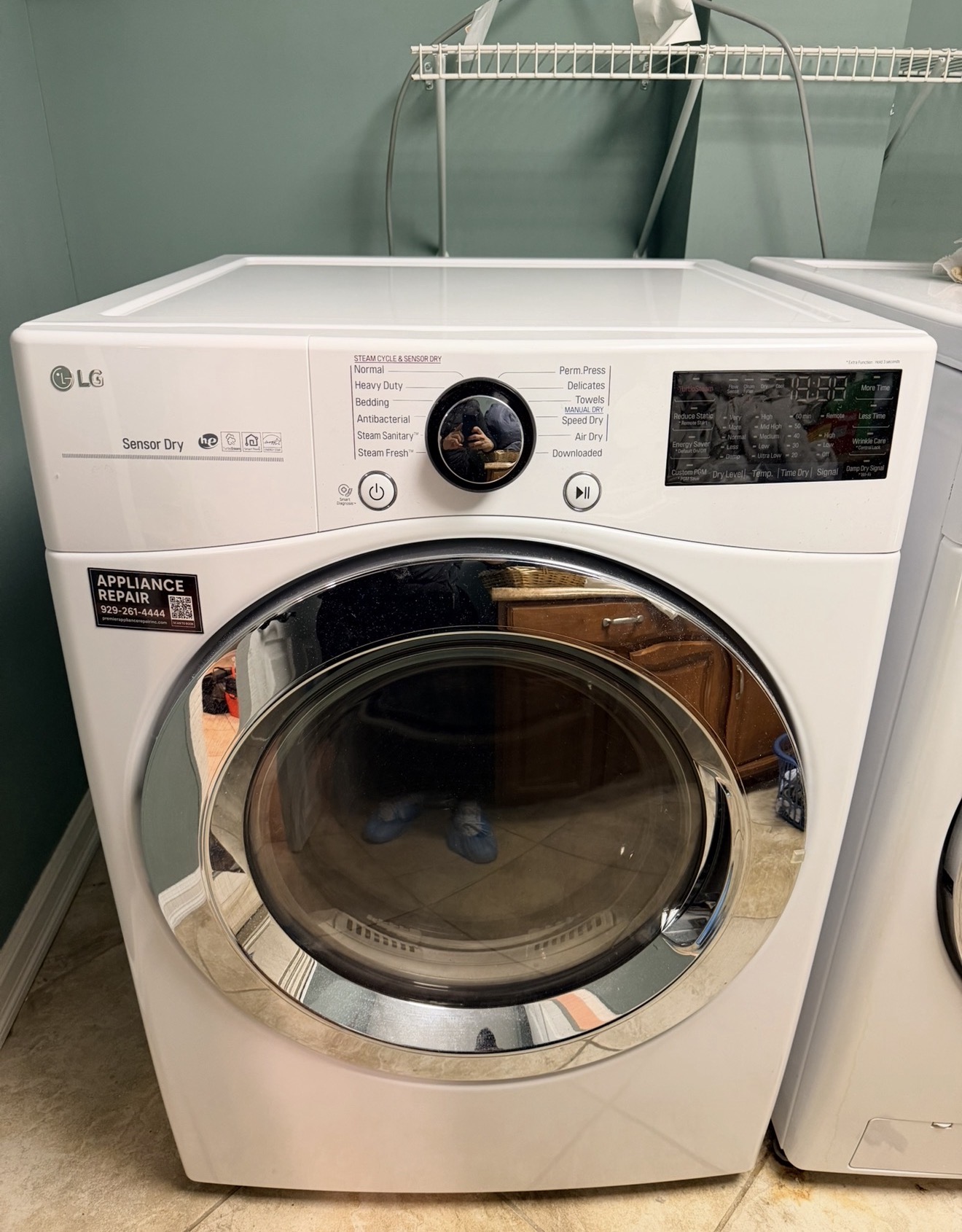
LG Sensor Dry dryer — tE diagnosis begins with the model number and code variant
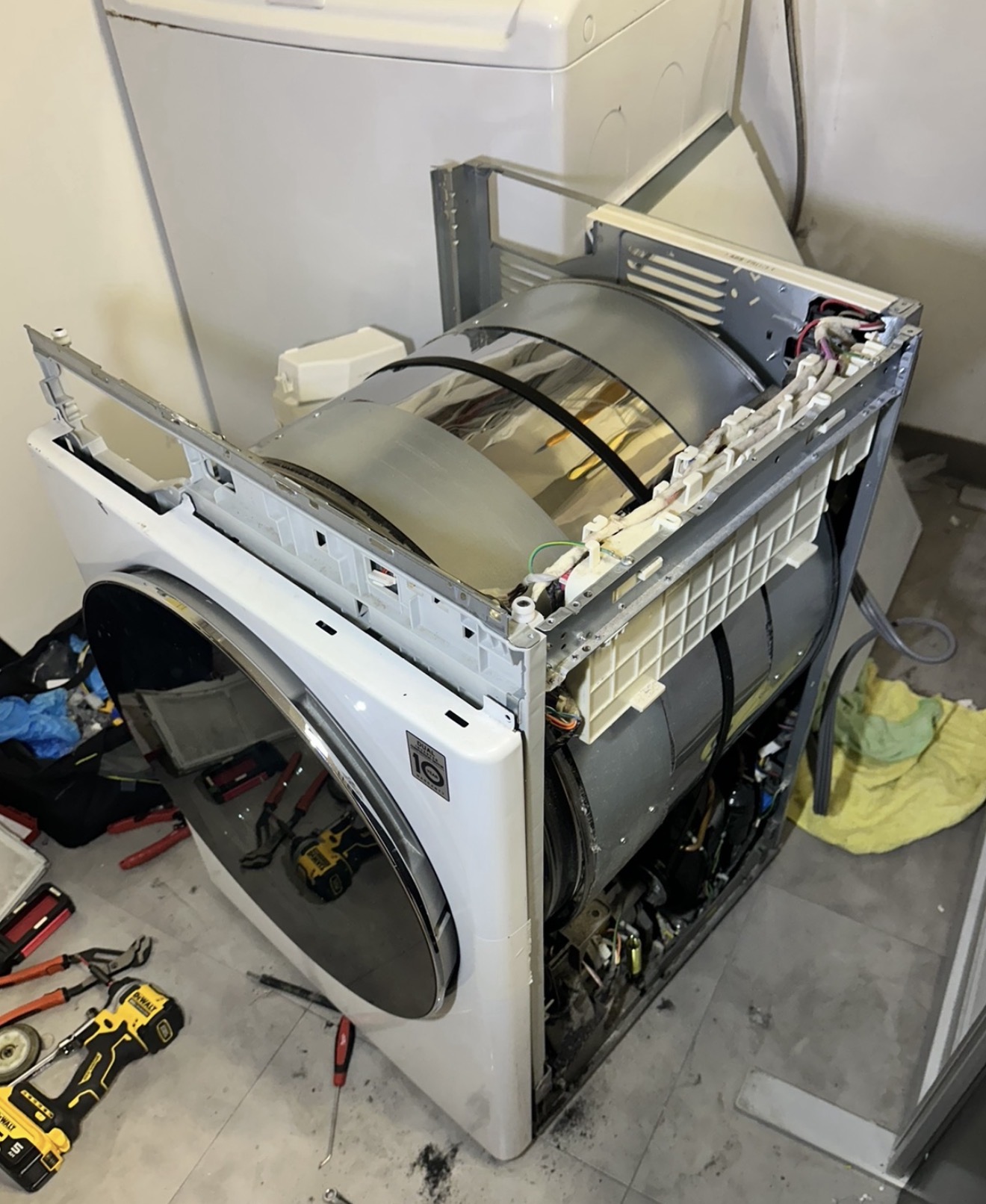
Cabinet opened — thermistor connector and sensor element tested separately
Thermistor replacement is one of the more accessible LG dryer repairs — the sensor is a small component and the labor to reach and replace it is moderate. In cases where only the connector needs cleaning rather than full sensor replacement, the repair is even more straightforward. You'll receive a full written quote before any work begins. The $80 service call applies toward your total.
The thermistor or its connector has degraded — a diagnosis and repair we perform same-day in 10309. No guesswork, 90-day warranty on the work.
📅 Book a Same-Day Visit 📞 Call (929) 261-4444LG uses a family of tE codes to identify which thermistor has faulted. The number after tE tells you exactly which sensor the board is flagging — which makes the on-site diagnosis faster.
The tE or tE1 code flags the main drum thermistor — the primary temperature sensor LG uses to monitor the drum environment. In Pleasant Plains and Princes Bay basement laundry rooms, connector oxidation on the tE1 sensor lead wire is the most frequent cause. The code may appear immediately at cycle start or after the dryer has been running for several minutes, depending on whether the connector fault is permanent or thermally variable.
The tE2 code points to the exhaust thermistor — positioned near the duct outlet to monitor the temperature of air leaving the drum. This sensor is in the exhaust airstream on every cycle, making it more directly exposed to humid exhaust air than the drum thermistor. In 10309 basement installations, tE2 failures from connector oxidation are a regular occurrence on machines that have been running for several years without connector maintenance.
The tE3 code flags the inlet thermistor, which monitors the temperature of air entering the heating chamber. A tE3 fault combined with a tE1 or tE2 in sequence often indicates a broader connector condition on the thermistor wiring harness rather than individual sensor failure. We test the full thermistor wiring path on every multi-code tE call.
📞 Call (929) 261-4444When a d80 code appears alongside or before a tE code, restricted vent airflow may be causing exhaust temperatures to run abnormally high — which the thermistor reads and reports. Before attributing a tE to sensor failure on a machine that has also shown d80, we check the exterior vent cap. If cap cleaning resolves d80 and the tE code clears, the thermistor may have been reading correctly — the exhaust temperature genuinely was out of range. If tE persists after d80 clears, the sensor needs testing.
📞 Call (929) 261-4444LG's Sensor Dry system uses metal sensor bars inside the drum to detect clothing moisture. In the same humid basement environment that degrades thermistor connectors, these sensor bars accumulate residue faster — fabric softener wax, fine lint, and mineral deposits from humid air combine to insulate the bars from accurate readings. An HS fault in a 10309 machine frequently resolves with sensor bar cleaning rather than replacement, and it's worth addressing on the same visit as a tE repair.
📞 Call (929) 261-4444When the board receives a temperature reading outside its acceptable range mid-cycle, it stops the dryer to prevent potential overheating damage. The tE code appears on the display and the door unlocks. Clothing may be damp or wet depending on how far into the cycle the shutdown occurred. The specific tE variant (tE1, tE2, or tE3) points to which sensor triggered the shutdown — information that speeds up the on-site diagnosis significantly.
An intermittent tE code — one that appears on some cycles but not others, or clears on reset but returns — is the signature of connector oxidation rather than a dead sensor. Oxidized connector pins have variable contact resistance that changes with temperature. When the connector is cold, the resistance may be acceptable and the cycle runs normally. As the connector warms through the cycle, resistance increases and the signal drops out of range. The tE code appears, the dryer stops. Cleaning and reseating the connector sometimes resolves this without part replacement — we assess and test both options on-site.
When a thermistor reads lower than actual drum temperature — a calibration drift rather than a complete failure — the board believes the drum is cooler than it actually is and allows the heating element to run longer or at higher output. Clothes come out very hot rather than warm, and synthetic fabrics may show heat damage. This drift mode doesn't always generate a tE code because the reading, though incorrect, may not be far enough out of range to trigger the fault threshold. We test thermistor resistance against spec values on every no-code overheating call.
LG's Sensor Dry system uses both the moisture sensor bars and temperature data from the thermistors to decide when a load is dry. When the thermistor reads incorrectly, the temperature component of that calculation is wrong — the dryer may declare the load dry before it is (short cycle) or continue running well past dryness (long cycle). This symptom can appear without a tE code if the thermistor has drifted within the board's acceptable range but outside its accurate range. We test sensor accuracy alongside the connector condition on every Sensor Dry performance complaint.
Unplug for five minutes and restart. If the tE clears and the dryer runs normally for several cycles, monitor it — if it returns reliably, the thermistor or its connector needs to be tested and we should come out. If the code returns on the next cycle, that's the answer — repeated resets don't fix the underlying condition. The tE variant (tE1, tE2, tE3) and whether it's intermittent or permanent both help us prepare the right part before arriving.
💡 One reset helps diagnose — repeated resets don't fixPleasant Plains and Princes Bay are on our regular South Shore route. After you call or book, we confirm your arrival window — same-day is typical. The $80 covers travel, full diagnosis, and a written quote. No work starts without your approval.
We test the thermistor connector pins before assuming the sensor has failed — in many 10309 basement installations, the connector is the fault and cleaning it resolves the tE code without part replacement. If the sensor element itself has drifted out of spec, we replace it and verify the code clears before closing the cabinet.
🔧 Precise diagnosis — replace only what failedWe run a complete drying cycle and confirm the tE code does not return before packing up. On LG ThinQ models we also check the app diagnostics. If HS sensor residue was found during the visit, we clean it on the same call so Sensor Dry accuracy is fully restored.
✅ 90-day warranty on every repair
Princes Bay faces Raritan Bay along the southwestern shore of Staten Island, a stretch of coastline that runs from the Great Kills Harbor area south toward Tottenville. The neighborhood developed primarily in the postwar decades — ranch homes and split-levels from the 1960s through the 1980s filling in the land between Woodrow Road and the water. It's a quiet, residential part of the South Shore where families have typically stayed for decades, and where the houses have the settled character of long-established suburban blocks.
The bay proximity that gives Princes Bay its name is also what creates the ambient humidity conditions inside these homes year-round. Basements in the lower-lying sections near the shoreline carry ground moisture regardless of season. Laundry rooms on the lower level — common in the ranch homes along Clarke Avenue, Seguine Avenue, and Bloomingdale Road — run LG dryers in an environment where connector oxidation accumulates faster than it would in a second-floor laundry or a properly ventilated utility room. The tE thermistor fault pattern in 10309 is a direct consequence of that environment operating on electronic components that were designed for drier conditions.
We cover all of 10309 regularly — Pleasant Plains, Princes Bay, and the residential streets between Woodrow Road, Hylan Boulevard, and the shoreline.
"My LG dryer kept showing tE1 and shutting off after ten minutes. Badma came the same day, tested the thermistor connector and the sensor element separately, found oxidation on the connector pins from our basement humidity. Replaced the thermistor, tested through a full cycle, code gone. He explained why it happens in basement laundry rooms near the bay — made complete sense once I understood it."
"tE2 code was stopping our dryer every single cycle. Badma diagnosed the exhaust thermistor within fifteen minutes — had the part, replaced it on the spot, tested it, done. He also explained the difference between tE1, tE2, and tE3 so I'd know what to tell him if it ever happened again with a different sensor. That kind of technical clarity is exactly what you want."
"The tE code was coming and going — sometimes the dryer ran fine for a whole cycle, other times it stopped after eight minutes. Badma said intermittent patterns point to connector oxidation rather than a completely dead sensor. He cleaned and reseated the connector, ran two full test cycles, and the code hasn't returned in two months. Precise diagnosis, no unnecessary parts replaced."
"LG dryer was stopping mid-cycle with tE. I'd googled it and thought it was going to be a major repair. Badma came, tested the thermistor against LG's resistance specs, found it had drifted, replaced it. The whole job took under an hour. He also noticed the Sensor Dry bars had residue and cleaned those too. Thorough without being pushy — just fixed what needed fixing."
"We've had our LG for six years and it's in the basement laundry room. tE1 started appearing last winter and got worse through the spring. Badma came, explained that basement humidity near the bay is exactly the environment where thermistor connectors degrade, replaced the sensor, and the dryer has run perfectly through the whole summer. Very knowledgeable about the specific conditions in this neighborhood."
"Called Saturday morning, Badma was here by early afternoon with no weekend surcharge. Diagnosed a tE3 code — inlet thermistor — replaced it and tested through a full cycle before leaving. He was courteous, wore shoe covers, explained everything clearly. Our LG has been running without a problem since. This is how service should work."
"My dryer wasn't throwing a code but the clothes were coming out way too hot and cycles were much longer than before. Badma tested the thermistor resistance against the LG spec and found it had drifted — reading low, so the board was letting the element run too long. Replaced it and drying times and temperatures are back to normal. Didn't need a code to find the problem."
The tE code means the LG control board has received a temperature reading from one of its thermistors that falls outside the expected range. The specific variant — tE1, tE2, or tE3 — identifies which sensor triggered the fault. In 10309's coastal basement environment, the connector pins on the thermistor lead wire are the first suspect: oxidation increases contact resistance, attenuating the signal and causing the board to read an out-of-range temperature. We test the connector before the sensor element to determine whether replacement is necessary.
Princes Bay faces Raritan Bay directly, and basement laundry rooms in the ranch and split-level homes along Clarke Avenue, Seguine Avenue, and Bloomingdale Road accumulate coastal humidity year-round. Every drying cycle draws that humid basement air through the dryer cabinet, past the thermistor sensor and its connector. Over years of operation, the connector pins oxidize and develop increased contact resistance — causing the tE code. The same environmental condition that makes lint stickier in Tottenville makes electronic connectors corrode faster in Princes Bay.
Each code points to a different sensor position. tE or tE1 is the main drum thermistor — the primary temperature sensor. tE2 is the exhaust thermistor, monitoring air leaving the drum. tE3 is the inlet thermistor, monitoring air entering the heating chamber. Each is a separate component that can fail independently. The code variant tells us exactly where to look first, making the diagnosis faster and more precise.
Temporarily, sometimes. If the connector has an oxidation fault that is thermally variable — worse when warm, better when cold — unplugging and restarting may clear the tE for one cycle before the connector warms and the fault returns. This intermittent pattern is useful diagnostic information: a code that reliably returns after a reset means the thermistor or its connector needs to be properly tested and addressed, not repeatedly reset.
The thermistor is a fully serviceable, replaceable component — not a reason to replace the dryer. It's a small sensor with a lead wire connector, and replacement is a moderate repair on an otherwise functional LG dryer. In cases where only the connector has oxidized rather than the sensor element itself, the repair may be even simpler: connector cleaning and reseating without part replacement. We determine which applies on every tE call before quoting anything.
Both neighborhoods are on our regular South Shore route. After you call or book online, we confirm your arrival window — same-day is typical. Mon–Sat 8am–7pm and Sun 9am–5pm, no weekend surcharge. Call (929) 261-4444 to confirm today's availability.
All major LG dryer models including the DLE7300 and DLEX3700 electric series, the DLG3401 and DLGX5500 gas series, and the Signature DLHC1455. Thermistor specifications vary by model and code variant (tE1, tE2, tE3), so having your model number when you call helps confirm the correct part before the visit. Call (929) 261-4444.
Yes. Every repair carries a 90-day parts and labor warranty. If the tE code returns within 90 days of our thermistor replacement, we come back at no charge. In a high-humidity basement environment where connector oxidation is ongoing, we may also discuss whether a second thermistor in the same harness is showing early degradation — so the new sensor doesn't face the same conditions that degraded the last one.
LG dryer showing tE, tE1, tE2, or tE3 on Woodrow Road, Clarke Avenue, Seguine Avenue, or anywhere in Pleasant Plains or Princes Bay — try one reset, note whether the code returns, then call us. Same-day service, 90-day warranty.